Loading...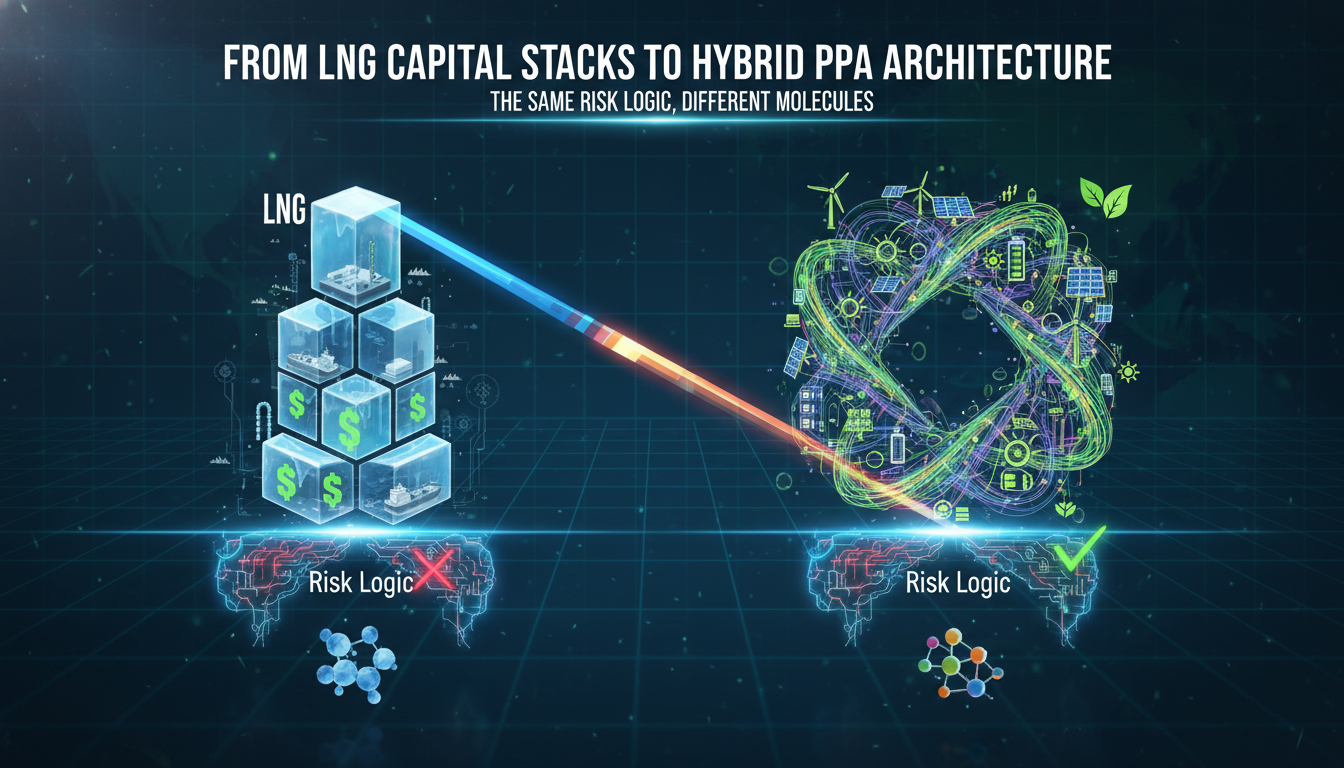
If you followed the LNG Capital Stacks 101 thread, you already know the core bankability logic: an offtake agreement is not a sales contract. It is a risk allocation instrument. It determines who absorbs price risk, volume risk, and credit risk across a project's financing life — and those allocations drive every covenant in the debt package. Keep that framework in your working memory, because Amazon just executed nine power purchase agreements simultaneously in Australia, and the architecture underneath that headline is the same logic, applied to electrons instead of molecules.
Amazon's bundle — reported as the largest single corporate renewable procurement tranche in Australian history — pairs the majority of its PPAs with co-located battery energy storage systems (BESS). The IEA has framed the macro backdrop clearly: AI could double global data center power consumption by 2030.[1] Amazon's move is not a green credential exercise. It is an early defensive procurement against a supply-constrained market where hyperscalers are now the anchor creditworthy offtaker that industrial buyers occupied for the previous generation of project finance deals.
The Tolling Analogy: Who Controls the Battery?
In an LNG capital stack, the tolling structure separates capacity rights from commodity exposure. The toller pays a fixed capacity charge to access the liquefaction or regasification terminal; the commodity price risk sits with the offtaker, not the project. The project finance lender gets a predictable revenue stream tied to capacity availability, not spot price movement.
In a hybrid PPA with co-located BESS, the analogous question is: who controls dispatch? If the battery operates under a separate storage services agreement — with the developer or a third-party optimizer controlling charge/discharge — the PPA settlement and the storage revenue streams are legally and financially distinct instruments. The developer can stack an LGC (Large-scale Generation Certificate) revenue stream from the renewable generation against a frequency control ancillary services (FCAS) revenue stream from the battery, and the corporate offtaker's PPA sits across only one of those layers.
This matters for bankability because a lender sizing debt service coverage ratios needs to know which revenue stream is senior, which is merchant, and how the battery dispatch protocol interacts with the PPA's shape and volume obligations. Amazon's investment-grade balance sheet is doing the credit support work that an LNG buyer's letter of credit or parent guarantee did in the prior generation of deals — but the structural complexity underneath that creditworthy name is materially higher than a vanilla sleeved PPA.
Tenor Mismatch: The New Bankability Problem
In the LNG thread, we worked through refinancing risk — the gap between a project's debt tenor and the offtake contract term. The same mismatch problem appears in hybrid PPA architecture, but with a physical dimension added: battery degradation.
A 15-year PPA written against a BESS asset with a 10-year useful cycle life creates a structural mismatch that has to be resolved somewhere in the agreement. Either the developer assumes replacement capex risk in years 11 through 15 (and lenders need to underwrite that assumption), or the PPA includes a performance degradation schedule that adjusts settlement volumes as capacity fades, or the storage component is ring-fenced under a separate agreement with its own term and refresh provisions.
The IEA warns AI could double global data center power consumption by 2030 — making hyperscaler procurement windows front-loaded and developer leverage higher than at any prior point in the corporate PPA market.
None of these solutions is wrong. All of them have financing implications that do not appear in the headline deal announcement. When you see "Amazon signs 9 PPAs with storage," the bankability question is: where does the battery degradation risk sit, and has the lender's technical advisor signed off on the replacement cost assumptions in the base case model?
Why Nine Counterparties? The Optionality Argument
The multi-counterparty structure deserves its own analytical frame. An LNG buyer signing with a single seller concentrates counterparty risk and gives up negotiating leverage on future tranches. A portfolio of tolling agreements across multiple trains or terminals distributes that risk — and preserves the buyer's ability to walk away from marginal positions if the market shifts.
Amazon's nine-counterparty bundle achieves the same optionality at the PPA layer. Nine separate project agreements mean nine separate termination provisions, nine separate force majeure clauses, and nine separate grid connection timelines. If two projects slip their commercial operation dates, Amazon's AI facility uptime is not contingent on both. The redundancy is engineered into the procurement structure, not bolted on after the fact.
This is particularly relevant given the current pricing environment. Solar PPA prices rose in Q1 2026 on permitting headwinds and tariff-driven module cost pressure.[2] Buyers who delay multi-counterparty aggregation face both higher strike prices and a narrower field of shovel-ready counterparties. The M&A signal reinforces this: KKR-backed CleanPeak's acquisition of Sustainable Energy Infrastructure — a sub-5MW solar and BESS specialist — consolidates exactly the developer segment Amazon is contracting.[3] Institutional capital is vacuuming up the counterparty optionality that slower-moving corporate buyers will need in 18 months.
What to Watch Next
Three milestones will test whether this structure becomes the template for AI-era corporate offtake in Australia and comparable markets. First, watch for grid connection confirmation on Amazon's nine projects — AEMO's connection queue in the NEM is the operational chokepoint, and COD slippage across multiple projects simultaneously would stress-test the redundancy argument. Second, monitor the LGC forward curve: structural surplus has historically kept LGC prices suppressed, but accelerating hyperscaler demand is beginning to tighten the forward market, and a meaningful LGC price move changes the economics of the renewable generation component relative to the storage revenue stack. Third, track whether Microsoft or Google responds with comparable bundled procurements in the Australian market — competitive hyperscaler procurement behavior in a supply-constrained grid is the clearest signal that developer leverage has structurally shifted.
The molecules changed. The risk logic did not. If you can read an LNG capital stack, you can read a hybrid PPA — you just need to substitute storage dispatch agreements for tolling schedules, LGC settlements for cargo nominations, and battery degradation curves for regasification terminal availability factors. The next piece in this series will work through a simplified model of how a lender's technical advisor would stress-test the BESS replacement capex assumption in a 15-year hybrid PPA base case.
References
- "IEA warns AI could double data centre power use by 2030," Modern Power Systems, April 20, 2026. https://www.modernpowersystems.com/news/iea-warns-ai-could-double-data-centre-power-use-by-2030/
- "California powers its massive water pumps with 105 MW Kern County solar project," PV Magazine USA, April 20, 2026. https://pv-magazine-usa.com/2026/04/20/california-powers-its-massive-water-pumps-with-105-mw-kern-county-solar-project/
- "CleanPeak acquires sub-5MW solar and battery storage specialist Sustainable Energy Infrastructure in Australia," Energy Storage News, April 20, 2026. https://www.energy-storage.news/cleanpeak-acquires-sub-5mw-solar-and-battery-storage-specialist-sustainable-energy-infrastructure-in-australia/
- "KKR-backed CleanPeak acquires Sustainable Energy Infrastructure," Energy Magazine Australia, April 20, 2026. https://www.energymagazine.com.au/kkr-backed-cleanpeak-acquires-sustainable-energy-infrastructure/